

 By
Anne Turner
By
Anne Turner
Many organizations rely on static, point-in-time information to evaluate risk and security decisions, especially when it comes to sensitive data. Businesses process vast amounts of data every day, across complex, dynamic environments. While systems inventories and application registers document where data might exist, many such documents are captured periodically and refreshed infrequently.
Businesses rely on documentation about the data or its systems, but don't take evidence from the data itself. Each of those documents is an assertion. A systems inventory records where data was designed to sit, a retention schedule records how long it was meant to be kept, and a vendor contract records what a supplier agreed to delete. Assertions are treated as controls until an incident shows the gap between what was documented and what was actually held.
Customer personally identifiable information remains the most frequently compromised data type, appearing in 52% of breaches studied for IBM's 2026 Cost of a Data Breach report. Data of this kind is valuable in its own right, and it's also used as leverage for subsequent extortion attempts against the affected organization and its customers.
Data intelligence closes the gap between documentation and reality. It starts not with classification, policy or access review, but with establishing what the data estate actually contains. That foundation is what makes everything built on top of it — sensitivity, exposure, access, remediation — reliable rather than assumed.
The intelligence gap
When data intelligence is missing, controls are weakened, potentially leading to incidents and breaches. Take these four scenarios, each illustrating a control that didn’t reflect the current data reality:
-
The planned deletion that never took place. This isn’t uncovered until the dataset is breached, and the scope of what’s affected expands as more undeleted data comes to light through the investigation.
-
The data without an owner. Without data stewardship, sizable datasets can exist without anyone directly accountable for them. Over time, these datasets risk becoming forgotten, hidden, untracked and unmanaged.
-
The “just in case” information. Several high-profile incidents have been the result of the over-collection or over-retention of sensitive information, most notably within customer verification processes.
-
The propagation effect. System extracts are shared via productivity tools, copied to a local drive and re-uploaded to a different SaaS application and shared again. These secondary copies aren’t protected by the same controls as the source, nor are they monitored and tracked throughout their journeys.
What data intelligence actually is
For each of these scenarios, the missing piece is a current picture of data reality. In each case, the organization held a belief about its data that data intelligence would have contradicted.
| Data intelligence is an evidence-based understanding of the sensitive data an organization holds: where it exists, and who and what can reach it. It grounds risk decisions in the actual state of the data rather than assumptions about it. |
Discovery is the foundation for data intelligence. Access governance, classification and exposure management all depend on the quality and completeness of the discovery step.
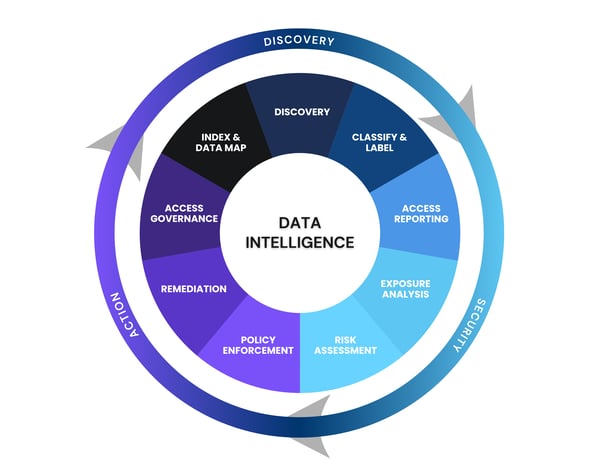
Data intelligence for next-generation risk
That foundation applies across next-generation risk: compliance, resilience, due diligence, digital transformation. AI and post-quantum migration make the case most directly, for different reasons.
AI is expanding the data footprint itself, creating new copies and destinations faster than most organizations can track. Meanwhile, quantum migration raises the stakes of not knowing where your most vulnerable sensitive data is located.
Responsible AI deployments need to ensure that models and agents only access information that is necessary for their purpose and present information that users and customers are authorized to view. This means ingestion sources must be cleaned of any unauthorized data before enabling AI services.
Separately, quantum migration is framed as a cryptography problem, replacing vulnerable algorithms with post-quantum cryptography (PQC). However, this will be a costly and time-consuming process that requires prioritization. Prioritization depends on knowing which data will still be sensitive by the time it's decrypted – personal data, financial records, trade secrets and other long-lived information carry risk under "harvest now, decrypt later" scenarios regardless of when quantum decryption becomes practical.
It’s not just new technology that requires data intelligence.
-
PCI DSS and privacy compliance depend on knowing where regulated data actually sits, not where it was designed to sit.
-
Continuity and resilience planning assumes an accurate picture of what needs protecting and recovering.
-
M&A due diligence is only as reliable as the target company's own visibility into its data.
-
Digital transformation and cloud migration projects routinely surface data nobody accounted for in the original plan.
Putting data intelligence into practice
Discovery is the starting point for data intelligence. Enterprise Recon locates sensitive data across cloud, SaaS, on-premises and endpoint environments as it actually exists, giving organizations the ability to assess exposure, prioritize remediation and validate controls against their data reality.
Not every organization has the capacity to run that process at scale or the expertise to effectively analyze their results. Ground Labs' Professional Services team can undertake the scanning and analysis directly, delivering a current view of an organization's sensitive data landscape.
Next-generation risk mitigation depends on data intelligence - an accurate and current picture of the data an organization actually holds across environments subject to continuous change.