

Sensitive data discovery is the foundation for stronger security, better governance and more sustainable compliance. Ground Labs Enterprise Recon helps organizations turn visibility into action by discovering, reporting and remediating sensitive data across complex environments.
What is sensitive data?
In 2026, organizations are processing more data than ever before. According to the IDC, current data volumes are around 175-180ZB and expected to grow to almost 400ZA by 2028. In addition, as much as 90% of all business data is unstructured. Worryingly, much of this data is sensitive and requires specific management, control and oversight to keep it safe.
Any sort of data might be considered sensitive, depending on the nature of the business. Some types of data must be protected according to local laws and regulations, such as personal data and financial information.
Other types of data are considered sensitive because they would pose a threat to the business if they were exposed inappropriately, such as: access keys and authentication credentials; intellectual property; proprietary information; client data; or pre-release sales, marketing and product information.
What is sensitive data discovery?
Sensitive data discovery is the process of uncovering the types of data that are valuable to an organization across their technology estate, to ensure they are adequately protected against unauthorized disclosure, cyber-attack and data breach.
Data discovery shows where this data resides across an organization’s digital environment – on-premises and in the cloud. It also helps find data stored on end user devices, like company laptops and workstations.
With this information, organizations can:
-
uncover hidden stores of sensitive data they didn’t know about
-
bring unmanaged data stores under centralized control
-
verify access permissions applies to sensitive data stores
-
remediate exposed data using encryption, masking or deletion
There are many reasons organizations may want to implement data discovery, including:
| Data breach | Leadership change | Projects and programs | Audit and compliance |
| As part of breach investigation processes and post-breach mitigation activities to improve data security controls | Understand the data landscape of the organization quickly to support early strategic decision-making | Pre-requisite of major change projects including digital transformation, cloud migration, M&A and AI initiatives | Establishing and revalidating data security and compliance with demonstrable evidence for internal and external audits |
How data discovery works
Historically, sensitive data discovery has been a manual process of knowledge-based information gathering based on operating procedures and an understanding of data flows through company systems. When businesses operated across one or two major databases in physically defined on-premises networks, this approach to discovery was sufficient for many use cases.
Today, business data landscapes have exploded from on-premises to hosted infrastructure, into cloud platforms and SaaS applications, and now into AI tools and services. Their environments have become increasingly fragmented and complex, and with it higher security risk. With the global average cost of a data breach at $4.44 million, according to IBM’s 2025 report, visibility into where sensitive data resides is increasingly foundational to reducing risk.
Four steps to effective data discovery
Organizations retain vast amounts of information across a digital landscape that extends far beyond any physical infrastructure they manage. Without the right tools, discovery can be a costly and resource intensive exercise. However, there are ways to simplify data discovery and make sure it’s efficient and effective.
-
Be specific about what you’re looking for – almost any kind of information can be sensitive, so it’s important to understand what data you are looking for when setting up your discovery strategy.
-
Define where you want to search – modern business networks aren’t walled environments any more. Most organizations operate across hybrid cloud and on-premises networks, and increasingly use SaaS applications and AI technologies that push sensitive information into third-party environments. Additionally, almost 90% of all business data is unstructured, potentially including unknown and hidden repositories of sensitive and high-risk data.
-
Use the right discovery tool – When you know what you’re looking for and where you want to be able to search, you can select a discovery solution that satisfies your requirements.
-
Make your process repeatable – Data is constantly being created, moved and shared, so it's critical that any discovery process can be repeated often, to capture new stores of sensitive information before they become a major security risk.
Data discovery with Ground Labs Enterprise Recon
Ground Labs Enterprise Recon uses context-defined pattern matching to identify and verify sensitive data, based on comprehensive pattern definitions. This means it can be both fast and accurate, uncovering hidden stores of sensitive information with minimal operational impact.
Ground Labs Enterprise Recon supports discovery for more than 300 PII data types and custom data patterns, across most commonly used platforms and services, and storage formats – including structured, unstructured and volatile data stores. Scans can be run on demand or set up to run on a recurring schedule, supporting repeatable and ongoing discovery monitoring of high-risk systems and services.
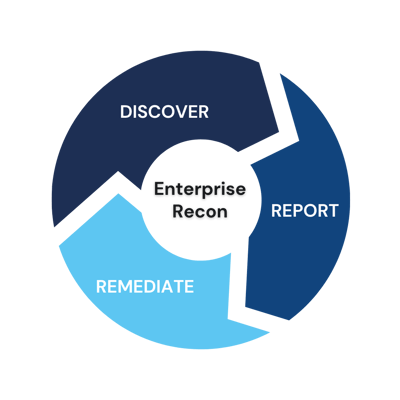 Discover, report and remediate sensitive data with Ground Labs Enterprise Recon
Benefits for compliance and security
Sensitive data discovery is about more than just identifying personal data and company sensitive information.
For security teams, data discovery helps uncover where sensitive information is located across cloud platforms, databases, file shares, legacy systems and unstructured repositories. That visibility makes it easier to reduce exposure, prioritize remediation, strengthen access controls and focus protection efforts where risk is highest.
For compliance functions, it provides the foundation for understanding what regulated data exists, where it is stored, how it is used and which systems or business processes it touches. That makes it easier to meet legal and regulatory obligations for data inventories, records of data processing, audit readiness, retention, risk assessments and consumer privacy rights.
“From a governance perspective, one of the biggest challenges is understanding where sensitive data exists across the business. Without that visibility, both risk management and compliance become much harder to sustain.”
How Ground Labs Enterprise Recon helps compliance and security
Ground Labs Enterprise Recon empowers organizations to identify where their sensitive data lives, reduce unnecessary exposure, improve risk prioritization and satisfy regulatory requirements with demonstrable evidence.†
| Privacy and data protection laws | Requirements | Enterprise Recon for security | Enterprise Recon for Compliance |
| Australia Privacy Act (APA) | Reasonable steps to protect personal information and governance control over how it is handled and retained | Uncovers where personal information is stored and enables on-demand remediation for at-risk data | Supports compliance with Australian Privacy Principles (APPs) including security, retention and individual privacy rights |
| CCPA/CPRA | Visibility into personal information, purposes of use, sharing practices and support for consumer rights | Identifies where consumer information and sensitive personal information resides for management and remediation | Locate consumer information and support consumers by upholding their data privacy rights |
| EU DORA | ICT risk management, documentation of critical information assets and operational resilience | Identifies critical data assets, supporting inventory management, system dependencies and resilience risks | Supports documentation, inventory, risk scoping and evidence gathering for resilience planning and regulatory review |
| EU GDPR | Visibility of personal data, records of processing, data security controls, and support for consumer privacy rights and subject access requests | Find and protect personally identifiable information and special category data, and remediate exposures | Supports asset discovery, record of processing activities (ROPA), DSAR processes, retention and personal data governance |
| HIPAA | Protection of ePHI and risk analysis across systems and providers that store or process it | Identify where ePHI exists including unexpected locations, for management and control | Ensure HIPAA Security Rule and Privacy Rule obligations are applied to all in- scope data |
| PDPA | Management of personal information, data inventories and governance processes | Discover where personal data is stored and apply mitigations to reduce exposure risk | Locate personal data and support individuals through ongoing privacy program maintenance |
| Data security standards | Requirements | Enterprise Recon for security | Enterprise Recon for compliance |
| ISO27001 | Risk-based security protection of information assets and systems in a robust ISMS | Understand where sensitive information is located, and classify it, enabling enforcement of security controls | Supports risk assessment, asset inventory, audit preparation and continual improvement |
|
NIST Cybersecurity Framework (CSF) |
Clear understanding of data, systems and risk to apply appropriate security controls | Identify sensitive data, exposure and remediation needs | Supports data inventory and flow mapping, privacy risk assessments and provides evidence for governance and audit |
| PCI DSS | Protection of cardholder data through scope reduction and defined security controls | Define and revalidate PCI DSS scope; identify and mitigate unexpected stores of cardholder data | Supports PCI DSS scoping and scope revalidation, retention clean-up and incident response requirements |
| SOC2 | Demonstrable security, privacy and confidentiality controls under a robust management framework | Identify sensitive and confidential data within scope, to validate control coverage | Provides evidence to support data handling practices, privacy and data security controls |
Common challenges in data discovery
The most common challenges of sensitive data discovery can be split into six main areas:
-
Fragmented environments with limited centralized visibility - sensitive data is distributed across endpoints, servers, databases, network storage, email and collaboration tools, and cloud environments. Further, control is no longer centralized, leaving a visibility gap for coordinated governance and risk management. Software like Enterprise Recon is designed to limit these blind spots and reduce data risk.
-
Finding sensitive data in unstructured repositories – much of the data organizations store is unstructured, in files, folders, emails and mixed content repositories rather than structured databases. This makes discovery more challenging, with significantly higher error rates when using manual or script-based discovery. Enterprise Recon delivers context-based pattern matching to both structured and unstructured data environments, minimizing false positives and delivering fast, accurate results.
-
Discovery without mitigation – discovery alone doesn’t reduce risk or eliminate data exposures. That’s why discovery needs to be backed up with remediation, like the on-demand remediation offered in software like Enterprise Recon. Techniques such as quarantine, masking, encryption and deletion allow data exposures to be effectively managed as soon as they are identified.
-
Scoping and maintaining compliance environments – businesses often struggle to manage and maintain privacy compliance with global laws like GDPR and CCPA, and security certifications such as ISO27001 and PCI DSS, because they’re unable to identify where regulated data resides. Enterprise Recon provides more personal data patterns than any other software supporting faster identification and mitigation for security and privacy compliance efforts.
-
Disconnected discovery and classification – data management and security controls like data loss prevention (DLP) rely on data classification to perform effectively. To facilitate this, some discovery solutions, like Ground Labs Enterprise Recon PRO, include sensitivity labeling of data assets through integrations with services like Microsoft Purview.
-
One-size-fits-all solution deployments – as many solutions move to SaaS-only, cloud-based subscription offerings, some businesses are forced away from incumbent tools – especially those in more highly regulated sectors and locales. Enterprise Recon offers local and cloud-based deployment options, with master server appliance installations on-premises or Enterprise Recon Cloud (available via AWS Marketplace) deployed within a customer’s own AWS environment. Both deployment modes support agent- and agentless scanning, across on-premises and cloud platforms.
“In fast-changing environments, visibility is what enables control. Sensitive data discovery helps organisations strengthen security while also supporting better governance and more resilient operations.”
Key takeaways for sensitive data discovery
What is sensitive data discovery?
Sensitive data discovery is the process of identifying valuable or regulated information across an organization’s digital environment, including on-premises systems, cloud platforms, SaaS applications and end-user devices.
What is sensitive data?
Sensitive data can include PII, financial information, ePHI, cardholder data, intellectual property, credentials, proprietary business information and other data that could harm the organization if exposed unintentionally or in a data breach.
Why does sensitive data discovery matter now?
Data volumes are growing rapidly, environments are more fragmented and most business data is unstructured. That makes it harder to know where sensitive data lives and easier for risk to build up unnoticed.
What does data discovery help organizations do?
It helps them uncover hidden data stores, bring unmanaged data under control, verify access permissions and remediate exposed data through actions such as encryption, masking or deletion.
How does Ground Labs Enterprise Recon support data discovery?
Enterprise Recon uses context-defined pattern matching to identify and verify sensitive data quickly and accurately, with support for more than 300 PII data types and custom patterns across structured, unstructured and volatile data stores. It provides built-in remediation options, support for compliance use cases, integration with Microsoft Purview for sensitivity labelling, and flexible on-premises or cloud deployment options.
Want to take the next step toward actionable sensitive data discovery?
Download your free guide, Data discovery for privacy compliance, and learn how to locate and manage sensitive data across your organization.