

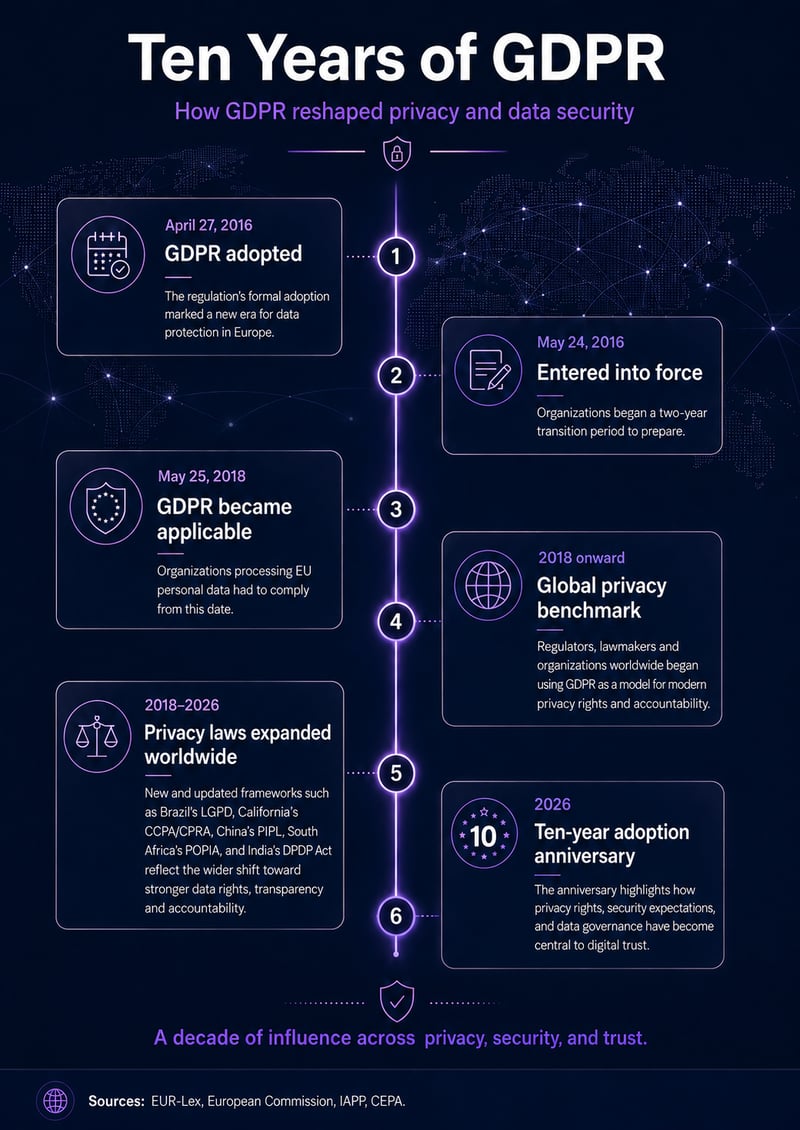
Ten years ago, the European Union adopted the General Data Protection Regulation, better known as GDPR. It was adopted on April 27, 2016, entered into force on May 24, 2016, and has applied across the EU since May 25, 2018.
The GDPR gave individuals stronger rights over their personal data and made organizations accountable for how that data is collected, stored, used, shared and protected. The European Commission marked the regulation’s tenth anniversary by describing it as a “landmark law [that] gave Europeans real control over their personal data for the first time, and changed life online forever.”
Its influence extends beyond compliance, establishing privacy as a business issue driven by consumer expectations about how their personal information should be treated by the companies they entrust it to.
GDPR helped make personal data protection a global priority. Ten years later, the organizations best placed to meet privacy expectations are those that understand their data deeply enough to manage, secure and govern it effectively.
The privacy pioneer: GDPR’s global influence
The GDPR was crafted for European Union (EU) member countries and applied across the European Economic Area (EEA), providing a core framework for privacy across the bloc. Its impact, however, soon became global.
Since its introduction, the GDPR has become a reference point for privacy legislation around the world. It has been used as the basis of national legislation including Brazil’s LGPD, Singapore’s PDPA, New Zealand’s Privacy Act, China’s PIPL, South Africa’s POPIA, India’s DPDPA, Saudi Arabia’s PDPL. It has also informed the development of US state legislation including California’s CCPA, which has itself been used as a legal template across many states.
The regulation also changed consumer expectations. People are more aware of their privacy rights than ever before.
According to a 2026 YouGov Profile report, 59% of British consumers say they are concerned about how much data is collected about them online. Recent European consumer research also suggests privacy concern remains high, with almost nine in ten Europeans concerned about digital privacy.
Increasing consumer demand has further shifted organizational behavior. Privacy is no longer a policy-based exercise, with consumers and regulators alike pushing organizations to demonstrate how they protect individuals’ personal data alongside their policy claims.
Strategic enforcement for growing maturity
According to DLA Piper’s January 2026 GDPR Fines and Data Breach Survey reported a higher cumulative total of €7.1bn across surveyed countries by January 10, 2026. It also reported that European supervisory authorities issued around €1.2 billion in fines during 2025.
Monetary penalties and legal undertakings have become a normal part of the privacy landscape thanks to the GDPR. The data protection authorities (DPAs) set up across EU member countries have consistently brought enforcement action against organizations failing to address compliance failures.
This hasn’t been limited to action against large data breaches. The European Data Protection Board (EDPB) and European Data Protection Supervisor (EDPS) have led enforcement towards maturing the underlying requirements of the regulation, including
-
publicly available privacy notices
-
retention and deletion practices
-
security and access control around personal data
-
breach response planning and notification requirements
-
supplier and supply-chain due diligence
-
data subject access request processes
From GDPR compliance to data intelligence
GDPR compliance is about building security and data management practices that make compliance sustainable.
Strong cybersecurity controls protect personal data, while good data management practices support data minimization and retention goals.
Ten years after GDPR’s adoption, the organizations best prepared for privacy and security challenges are those that have the data intelligence capabilities, like those offered by Ground Labs Enterprise Recon, that drive informed decision making.
By identifying sensitive data, labelling it by sensitivity, assessing exposure and supporting mitigation, Enterprise Recon gives teams the visibility and context they need to improve privacy, strengthen data security and manage data posture more effectively.
Key takeaways
-
GDPR was adopted on April 27, 2016 and has applied across the EU since May 25, 2018.
-
In ten years, GDPR has helped make privacy a global business priority and influenced privacy laws and reforms around the world.
-
Enforcement remains active, with GDPR fines reaching over €7bn since 2018.
-
GDPR compliance is more sustainable when it is underpinned by strong cybersecurity controls and disciplined data management practices.
-
The data intelligence delivered by Ground Labs Enterprise Recon supports this approach by helping organisations identify, understand, secure and manage sensitive data across complex environments.
See how Ground Labs Enterprise Recon delivers data intelligence to assess personal data exposure and reduce risk across complex environments, request a demo today.