

 By
Anne Turner
By
Anne Turner
Verizon’s 2026 Data Breach Investigations Report analyzed more than 22,000 confirmed data breaches, reported within a 12-month period. We see new incidents reported daily in the industry press and it’s become routine to receive emails from companies letting us know our personal information has been affected by a breach.
It’s become trite to say that “it’s not if but when your organization will be breached.”
Unfortunately, it’s true – organizations will continue to face cyberattacks targeting their data assets. However, reducing the amount of sensitive information available to compromise is a crucial defence in reducing the impact of a successful attack.
Reducing exposure before the breach
There’s a lot that organizations can do to reduce their data footprint, address data exposures and limit the potential blast radius of cyber incidents.
In 2024, the FTC highlighted ways data management can be applied as an effective security measure, through retention schedules and proactive deletion strategies directly limiting the amount of sensitive information exposed to threats.
However, data management without data intelligence risks overlooking hidden and unknown stores of sensitive data. We see several recurring patterns that contribute to the unintentional build-up of data that can later result in expansive breach losses:
-
Excessive retention of data beyond its useful purpose. Keeping this data expands data volumes without adding value. Several breach settlements have cited the excessive retention of data as a factor in the scale of incidents, in some cases affecting millions of individuals.
-
Accumulating data outside core business systems. As businesses have continued to migrate from on-premises systems to externally managed environments, cloud computing and SaaS applications, the quantities of unmanaged and unstructured data within their digital environments have expanded. In many cases, without the visibility and oversight necessary to ensure effective control of sensitive data.
-
Legacy and inherited data. Businesses evolve over time, implementing new systems, migrating operations and decommissioning old platforms. Where this is incomplete, or information is retained “just in case,” these legacy environments become unmanaged and forgotten. Similarly, as businesses acquire others to expand their capabilities and grow, any unmapped data stores fall outside ongoing governance and management processes. In these cases, the double-edged sword of unmanaged systems and hidden data can lead to significant exposures in highly vulnerable environments.
Using data intelligence to reduce exposure
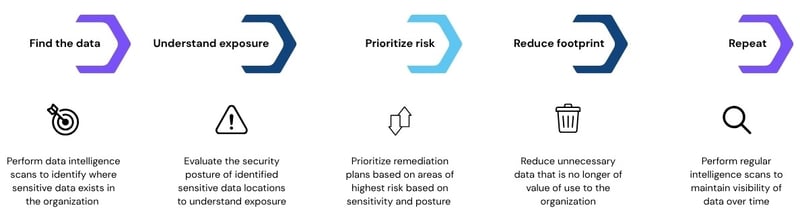
Enterprise Recon gives security and data teams the data intelligence they need to identify where sensitive information has spread beyond expected systems and whether the data still needs to exist.
That makes it useful for breach blast-radius reduction because the priority is not simply to find more data. It is to identify the data copies, legacy stores and unmanaged repositories that add exposure without adding value.
From there, teams can decide what needs to be removed, brought under stronger control or monitored more closely.
For organizations looking to build this into a repeatable data hygiene process, Enterprise Recon provides the underlying data intelligence to support that work across the estate.
Data intelligence for breach response
This capability also helps when the worst happens. Data intelligence means incident response can be planned based on knowledge of the information that was hosted on the compromised systems. This can speed up response times.
Poor visibility increases exposure before a breach, but it can also make it harder to assess and respond afterwards.
Several high profile incidents revise their estimates of affected data volumes and the types of data affected long after initially reporting the breach. This is, in part, due to the lack of estate-wide data visibility and understanding what data resides within the business and where it’s located.
Reduce data breach blast radius with data intelligence
Organizations can’t control every attack path, but they can control how much sensitive data is left exposed across the estate.
Better data hygiene reduces the amount of information available to compromise. Data intelligence makes that practical by identifying the hidden, duplicated and legacy data that sits outside normal management processes and would otherwise continue to add risk.
The same visibility also matters after an incident. Knowing what sensitive data was present on affected systems gives response teams a stronger starting point for scoping impact, prioritizing investigation and supporting regulatory assessment.
Enterprise Recon provides that underlying data intelligence, helping organizations reduce unnecessary exposure before a breach and understand the impact more quickly if one occurs.