

Data Security Posture Management is a continuous cycle of reducing data risk, and is becoming increasingly vital for organizations as their digital environments are more widespread and less centralized than ever before.
The adoption of generative AI tools has further driven the need for the visibility, management and control offered by DSPM – for both the training and development of responsible models, and the management of generated outputs.
However, DSPM can only be truly effective if it is built on the right foundations – comprehensive, accurate and up-to-date data discovery.
You can’t secure what you cannot see
Organizations today operate across cloud, on-premises and PaaS/SaaS services, fragmenting their digital estates and limiting centralized oversight of data across the systems and services driving their operations.
This complex landscape makes up the “attack surface of data,” and ensuring a clear and comprehensive view across it is fundamental to effective risk management, access governance, data security monitoring and remediation.
Data discovery is the foundational component of effective DSPM. Organizations can’t secure what they cannot see. The discovery process delivers that visibility across the data estate – identifying and cataloging new data stores as they emerge, and monitoring existing repositories over time.
While organizations host vast, known repositories of sensitive data – in databases, warehouses and data lakes – it also turns up in “accidental” and unknown locations. DSPM discovery aims to identify these assets and bring them into scope - continuously.
Discovery enables the DSPM lifecycle
DSPM is a continuous process, monitoring and managing the security posture of sensitive data. It’s ongoing because an organization’s data landscape is continuously changing, and data drift – from data generation/ingestion, duplication/proliferation, new locations, access modifications, etc. – is a key area of unknown risk.
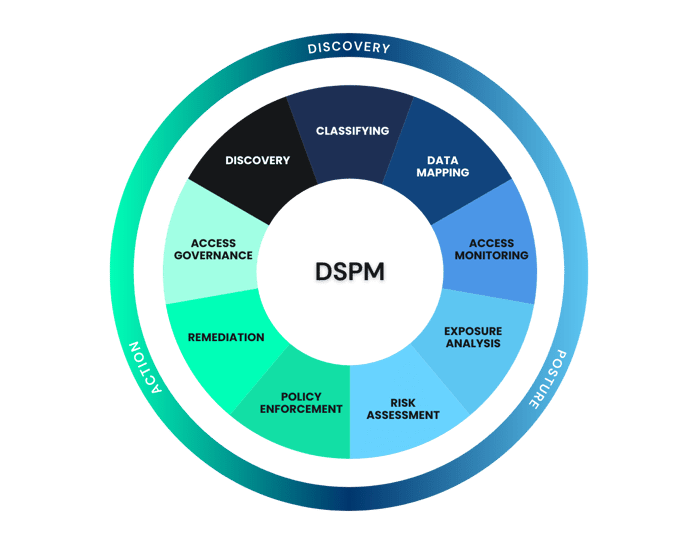
The DSPM lifecycle can be broadly divided into three main areas:
-
Discovery - identifying, classifying and mapping sensitive data
-
Posture – establishing current data risk through access monitoring, exposure analysis and risk assessment
-
Action – actively managing risk through policy enforcement, remediation and access governance
Discovery comes first, because it is the step upon which everything else depends.
Beyond discovery to classification
Discovery alone doesn’t provide an adequate baseline for effective DSPM, however. Discovery finds and maintains a catalog of assets, which must then be classified to provide the meaning DSPM needs to prioritize and enforce controls.
DSPM tools don’t just locate data; they categorize and classify structured and unstructured data so posture and exposure can be assessed accurately.
Without both discovery and classification, DSPM cannot be used to:
-
score risk
-
enforce least privilege
-
trigger exposure alerts, or
-
evidence regulatory compliance
Developing a data map for advanced intelligence
The core value of DSPM lies in the insight it offers of sensitive data risk. However, the appropriateness of the risk decisions it makes depends on accurate and comprehensive information about the data, including:
-
Where the data is – network location and geographic residency
-
What it is – the data type (e.g., address, driver’s license, national ID) and its sensitivity
-
Who can access it – unauthorized access and overprivileged access
-
How it is protected –data exposure and/or hosting infrastructure weaknesses
It’s the continuous discovery and classifying components of DSPM that enables more advanced analysis and assessment of sensitive data risk at an enterprise level.
Why DSPM begins – and succeeds – with discovery
Ultimately, organizations can’t protect sensitive data they don’t know exists. As businesses expand across distributed, hybrid environments and adopt new technologies like generative AI, comprehensive and continuous data discovery becomes the essential first step in reducing risk.
By ensuring a complete, current, and accurate understanding of where sensitive data lives and what it contains, organizations establish the foundation upon which meaningful classification, risk assessment, governance and remediation can occur. Discovery isn’t just the beginning of the DSPM lifecycle—it is the backbone that makes every subsequent action possible.
To find out how Ground Labs can help your DSPM strategy, request a demo or book a call with one of our experts today.